How to use this guide
Let the child choose a question. Ask what they notice in the picture before you explain more. Listen for the reason behind an answer. You can come back to a page together.
Nothing needs to be written down. The conversation starters are invitations, not quizzes.
Download the printable guide (PDF)
The game that goes with the book
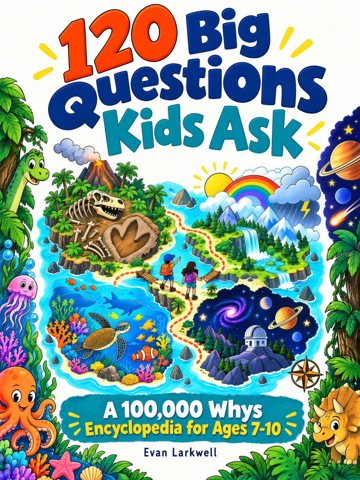
Big Question Islands has 8 islands and 120 short levels, one for each question, and every level points to its page in the book. The book shows how to open it.
CHAPTER 1
Everyday Science
Talk together
Compare the floating ship and the floating ice. What is shared, and what needs a different explanation?
Explain the difference between melting and dissolving using the pictures, without using the word disappear.
Trace a sound on its way to a wall and back. Which part of the route creates the delay?
Sources for each question
Q001Why can a heavy ship float?
- Density and Sinking and Floating — Teacher Background, American Chemical Society
Q002Why do things fall when we let go?
- Newton’s Laws of Motion — 1. Force and Inertia, NASA Goddard Space Flight Center
- What Is Microgravity? (Grades 5–8), NASA
- Falling Object with Air Resistance, NASA Glenn Research Center
Q003Why does a sliding toy eventually stop?
- College Physics 2e, 5.1 Friction, OpenStax, Rice University
- Newton’s Laws of Motion — 1. Force and Inertia, NASA Goddard Space Flight Center
Q004Why does ice float on water?
- Changing State—Freezing, American Chemical Society
- Concepts of Biology, 2.2 Water, OpenStax, Rice University
Q005Why does an ice cube melt?
- Changing State—Melting, American Chemical Society
- Changing State—Freezing, American Chemical Society
Q006Where does sugar go when it dissolves?
- Why Does Water Dissolve Sugar?, American Chemical Society
Q007Why are soap bubbles usually round?
- The Shape of Bubbles, Exploratorium; Ron Hipschman
- Soap, Exploratorium; Ron Hipschman
- When Bubble Meets Bubble, Exploratorium; Ron Hipschman
Q008How does a rainbow appear in the sky?
- College Physics 2e, 25.5 Dispersion: The Rainbow and Prisms, OpenStax, Rice University
Q009Why can we see ourselves in a mirror?
- College Physics 2e, 25.2 The Law of Reflection, OpenStax, Rice University
Q010How does sound travel from one place to another?
- College Physics 2e, 17.1 Sound, OpenStax, Rice University
Q011Why do we sometimes hear an echo?
- Introduction to Behavioral Neuroscience, 7.1 Acoustic Cues and Signals, OpenStax, Rice University
Q012Why do magnets stick to some things but not others?
- College Physics 2e, 22.2 Ferromagnets and Electromagnets, OpenStax, Rice University
Q013Why can a rubbed balloon make hair stand up?
- The Great Electron Rip-off!, American Chemical Society
Q014Why do some metal objects rust?
- Chemistry, 17.6 Corrosion, OpenStax, Rice University
Q015Why does popcorn pop?
- The Secret Science of Popcorn, American Chemical Society
CHAPTER 2
Space and the Universe
Talk together
Use the two diagrams to explain why an ordinary Moon phase is not the same as an eclipse.
Compare the changes that make a day with those that make a year of seasons.
Find one scientific question with an uncertain answer and one classification with written rules. How do they differ?
Sources for each question
Q016Why does the Moon seem to change shape?
- Moon Phases, NASA Science
- Eclipses and the Moon, NASA Science
Q017Why do day and night happen?
- What Is Earth? (Grades 5–8), NASA
- Chapter 2: Reference Systems, NASA, Basics of Space Flight
Q018Why does the Sun shine?
- Sun Facts, NASA Science
- (S-7) The Energy of the Sun, NASA Goddard Space Flight Center
Q019Why do stars look like tiny dots?
- Astronomy, 18.3 Diameters of Stars, OpenStax, Rice University
- Sun Facts, NASA Science
- Astronomy 2e, 17.1 The Brightness of Stars, OpenStax, Rice University
Q020Why are the planets so different from one another?
- Astronomy 2e, 14.3 Formation of the Solar System, OpenStax, Rice University
- Astronomy, 11.2 The Giant Planets, OpenStax, Rice University
- Solar System Temperatures, NASA Science
Q021Why does Saturn have rings?
- Saturn Facts, NASA Science
- StarChild: Saturn’s Cassini Division, NASA Goddard Space Flight Center
- Saturn’s Rings: Young and Ephemeral, Three NASA Ames Studies Say, NASA Ames
- Saturn’s rings age I: Reconsideration of exposure age, arXiv (research paper)
Q022Why do people see patterns in the stars?
- The Constellations, International Astronomical Union (archive hosted by ESO)
- What Are Constellations?, NASA Space Place
Q023Why do we have different seasons?
- What Causes the Seasons?, NASA Space Place
- Climate and Earth’s Energy Budget, NASA Earth Observatory
- Fact sheet 16 — World climates, Met Office, National Meteorological Library and Archive
- Our seasons, Met Office
- Orbits and Kepler’s Laws, NASA Science
Q024Why do astronauts float inside a space station?
Q025How can a rocket move through space?
- Chapter 3: Gravity & Mechanics, NASA, Basics of Space Flight
- Solid Rocket Engine, NASA Glenn Research Center
- Newton’s Laws of Motion — 1. Force and Inertia, NASA Goddard Space Flight Center
Q026Why do eclipses happen only sometimes?
- Eclipses and the Moon, NASA Science
- Eclipse Viewing Safety, NASA Science
Q027What makes a black hole different from other objects in space?
- Black Holes, NASA Science
Q028How can looking into space show us the past?
- What Is a Light-Year?, NASA Space Place
- Astronomy, 6.1 Telescopes, OpenStax, Rice University
Q029Could living things exist somewhere beyond Earth?
- The Search for Life: Are We Alone?, NASA Science
- Can We Find Life?, NASA Science
Q030Why is Pluto called a dwarf planet?
- Astronomy FAQs — Definition of a Planet, International Astronomical Union
- IAU 2006 General Assembly: Result of the IAU Resolution votes, International Astronomical Union
CHAPTER 3
Earth, Weather and Oceans
Talk together
Follow water through two routes and explain why a cloud is more than invisible water vapor.
Compare the evidence for an earthquake with the explanation of an eruption. Which processes are connected?
Explain why one rainy day does not tell you whether a place usually has a desert climate.
Sources for each question
Q031How does water travel around our planet?
- The Water Cycle, U.S. Geological Survey, Water Science School
- Hydrologic Cycle, U.S. Geological Survey
- Clouds, Met Office
Q032How can a cloud stay in the sky?
- Terminal Velocity and the Collision/Coalescence Process, Plymouth State University, Meteorology
- How Does a Cloud Rain?, University of Alaska Fairbanks, Geophysical Institute; Sue Ann Bowling
- Clouds, Met Office
- Rain, Met Office
Q033What makes the wind blow?
- What are the different types of wind?, Met Office
- Prevailing Winds, National Weather Service / NOAA
- Introduction and Overview Topics, NOAA NSSL; Elizabeth Smith, Ph.D.
Q034Why do we see lightning before we hear thunder?
- Understanding Lightning: Thunder, National Weather Service/NOAA
- Lightning and Cars, National Weather Service
- Lightning Safety, NOAA JetStream
Q035Why do snowflakes have such intricate shapes?
- A Snowflake Primer, Kenneth G. Libbrecht, California Institute of Technology
- Snow Crystal FAQs, Kenneth G. Libbrecht, California Institute of Technology
Q036How is climate different from today’s weather?
- What’s the difference between climate and weather?, NOAA Climate.gov
- United States Climate: Plot Description, NOAA Physical Sciences Laboratory
- Understanding Climate Normals, NOAA
Q037Why does the ground shake during an earthquake?
- The Science of Earthquakes, U.S. Geological Survey
- Can you predict earthquakes?, U.S. Geological Survey
Q038Why do volcanoes erupt?
- Volcanic Ash: Eruption Styles, U.S. Geological Survey
- Volcano Watch — All in a Day’s Work: Determining magma storage depths at Kīlauea, U.S. Geological Survey, Hawaiian Volcano Observatory
- Geology of Hawai’i Volcanoes National Park, U.S. Geological Survey
- U.S. Geological Survey Circular 1249, U.S. Geological Survey
Q039How can mountains grow and wear away?
- Parashant: A Boundary Between Geologic Provinces, National Park Service
- Geology and Physical Processes — Mountains, National Park Service
- Alaska Range and Mount McKinley: Geology and Orogeny, National Park Service
- Our Dynamic Desert: Weathering and Erosion in Desert Environments, U.S. Geological Survey
Q040Why do rivers often bend instead of running straight?
- Fluvial Features—Meandering Stream, National Park Service
- NPS Geodiversity Atlas—Arkansas Post National Memorial, Arkansas, National Park Service
Q041Why is the ocean salty?
- Why is the Ocean Salty?, USGS
- Teek and Tom Educator’s Guide — Lesson 4, NOAA Ocean Today
- Why is the ocean salty, but rivers flowing into it are not?, NOAA National Ocean Service
Q042Why does the sea rise and fall with the tides?
- Tides, NASA Science
- Are tides higher when the moon is directly overhead?, NOAA National Ocean Service
Q043How do waves move across the ocean?
- What causes ocean waves?, NOAA Ocean Exploration
- Lecture 2: Concepts from Linear Theory, Woods Hole Oceanographic Institution, GFD; Harvey Segur, notes by Alireza Mashayekhi and Michael Bates
- Drifters, NOAA Ocean Exploration
Q044Why is the pressure so great deep in the ocean?
- College Physics 2e — 11.3 Pressure, OpenStax / Rice University
- College Physics 2e — 11.4 Variation of Pressure with Depth in a Fluid, OpenStax / Rice University
- How does pressure change with ocean depth?, NOAA National Ocean Service
- Pressure Testing of New Alvin Personnel Sphere Successful, Woods Hole Oceanographic Institution
- How does pressure impact animals in the ocean?, NOAA Ocean Exploration
Q045Why do some places become deserts?
- Types of Deserts, USGS
- Antarctica, British Antarctic Survey
CHAPTER 4
Animals and Nature
Talk together
Follow the job of a leaf and the job of a flower. How do both support the plant differently?
Remove a decomposer from the pictured system. Name a possible consequence and something you would need to investigate.
Compare where a fish and a whale get oxygen. Explain why sharing an ocean does not make them the same kind of animal.
Sources for each question
Q046How do plants make their own food?
- Biology 2e — 8.1 Overview of Photosynthesis, OpenStax / Rice University
- The Science of Plants — 9.2 Seed Physiology, University of Minnesota Libraries
- PRATT — Plant processes, North Carolina State University, Home Horticulture / DELTA
Q047How does a seed grow into a plant?
- The Science of Plants — 9.2 Seed Physiology, University of Minnesota Libraries
- Biology 2e — 32.2 Pollination and Fertilization, OpenStax / Rice University
- Biology 2e — 8.1 Overview of Photosynthesis, OpenStax / Rice University
Q048Why do so many flowers attract bees?
- Biology 2e — 32.2 Pollination and Fertilization, OpenStax / Rice University
Q049Why do some leaves change color in fall?
- In Pictures: Autumn colour at Kew, Royal Botanic Gardens Kew
- Development of fall foliage color in sugar maple, US Forest Service / Van den Berg et al.
- Evergreen Perennials: The Greening of Winter, Penn State Extension
- Leaf & Needle Drop, Clemson University Cooperative Extension, HGIC 2353
Q050Why are fungi important even when we barely notice them?
- The wonderful world of fungi, Royal Botanic Gardens Kew
Q051What happens when one part of a food web changes?
- Biology 2e — 46.1 Ecology of Ecosystems, OpenStax / Rice University
- Biology 2e — 46.2 Energy Flow through Ecosystems, OpenStax / Rice University
- Grasshopper Sparrow Overview, Cornell Lab of Ornithology
- Food Habits of the Red Fox in Nebraska, Nebraska Academy of Sciences; University of Nebraska–Lincoln repository; Douglas G. Powell and Ronald M. Case
Q052How do birds stay in the air?
- Bernoulli and Newton, NASA Glenn Research Center
- Bird Academy’s A-to-Z Glossary of Bird Terms, Cornell Lab of Ornithology
- Species Profile: Swainson’s Hawk, Smithsonian National Zoo
- Habitat of Flight, Smithsonian Gardens
Q053How do fish breathe underwater?
- Biology 2e — 39.1 Systems of Gas Exchange, OpenStax / Rice University
- How do fish breathe?, Washington State University, Ask Dr. Universe
- The Silver King: The prehistoric fish that can breathe air, Smithsonian Ocean
- Dynamic elastocapillary coalescence of fish gill lamellae, Research article; PubMed Central, NIH/NLM
- Evaluating the Air Respiratory Capacity of Awaous (Chonophorus) tajasica (Gobiiformes: Oxudercidae): A Morpho-Functional Study, Trevisan et al.; Journal of Experimental Zoology Part A, Wiley; copia PMC
Q054Why is a whale a mammal instead of a fish?
- Whales and Dolphins, Smithsonian Ocean
Q055How does camouflage help an animal survive?
- Species variation game: peppered moth lucky landing, Natural History Museum, London
- Can you spot the hidden animals that use cunning camouflage?, Natural History Museum, London
- Predators hide against similarly coloured species to camouflage on the move, Matchette et al.; Proceedings of the Royal Society B; repository University of Cambridge
- Dichromats detect colour-camouflaged objects that are not detected by trichromats, M. J. Morgan, A. Adam, J. D. Mollon; Proceedings of the Royal Society of London B 248 (1992), 291–295; copia University of Cambridge
Q056Why do some animals migrate?
- Monarch Migration in the Southeast, US Fish and Wildlife Service
- Continental Nomads: Monarch Butterflies, National Park Service
- Monarch Butterfly Habitat Needs, USDA Forest Service
Q057How can some animals get through winter by hibernating?
- Arctic Ground Squirrel, National Park Service, Denali
- Biological clocks: Where arctic ground squirrels meet ’social jet lag’, University of Alaska Anchorage
- Cardiac Rhythms and Variation in Hibernating Arctic Ground Squirrels, Physiological and Biochemical Zoology 96(3), University of Chicago Press; ricercatori University of Alaska Fairbanks
- Freeze avoidance in a mammal: body temperatures below 0 degrees C in an Arctic hibernator, Science (Barnes, 1989)
- Arctic ground squirrels are supercooled, University of Alaska Fairbanks
Q058How does a caterpillar become a butterfly?
- Metamorphosis: The Life Stages of a Monarch Butterfly on Milkweed in North East, Maryland (FS-1144), University of Maryland Extension
- About Butterflies, Smithsonian Gardens
- Science Says So: How Do Caterpillars Get Their Wings?, Marine Biological Laboratory
- Monarch Butterflies Make the Most of the Smithsonian’s Gardens, Smithsonian Institution
Q059How can an ant colony work together?
- The Collective Wisdom of Ants, Deborah M. Gordon / Scientific American; Stanford University author-hosted copy
- ENY203/IG080: Ants, University of Florida IFAS Extension
Q060Why does having many different living things matter?
- What Is Biodiversity?, American Museum of Natural History
- High diversity stabilizes the thermal resilience of pollinator communities in intensively managed grasslands, Kühsel & Blüthgen / Nature Communications 6, 7989 (2015)
- Biology 2e — 46.1 Ecology of Ecosystems, OpenStax / Rice University
CHAPTER 5
The Human Body and Brain
Talk together
Follow nutrients from a meal toward the body’s transport system. Where do the two diagrams connect?
Choose one body diagram and explain which arrows show matter moving and which show information moving.
Recall a time when new information changed your interpretation. Share only what each person feels comfortable discussing.
Sources for each question
Q061Why do we have a skeleton inside our bodies?
- What Is Bone?, NIAMS / NIH
Q062What happens to food after we swallow it?
- Your Digestive System & How it Works, NIDDK / NIH
Q063Why do we need to breathe?
- How the Lungs Work — The Respiratory System, NHLBI / NIH
- Biology 2e — 39.1 Systems of Gas Exchange, OpenStax / Rice University
- Anatomy and Physiology 2e — 22.4 Gas Exchange, OpenStax / Rice University
- Anatomy and Physiology — Respiratory, University of Hawai‘i OER
Q064How do muscles move our bodies?
- Anatomy and Physiology 2e — 11.1 Interactions of Skeletal Muscles, Their Fascicle Arrangement, and Their Lever Systems, OpenStax / Rice University
- Anatomy and Physiology 2e — 10.3 Muscle Fiber Contraction and Relaxation, OpenStax / Rice University
- Anatomy and Physiology 2e — 10.4 Nervous System Control of Muscle Tension, OpenStax / Rice University
- Anatomy and Physiology 2e — 10.8 Smooth Muscle, OpenStax / Rice University
- What Makes You Move?, RockEDU / The Rockefeller University
Q065Why do we sweat when we get hot?
- Anatomy and Physiology 2e — 5.3 Functions of the Integumentary System, OpenStax / Rice University
- It’s the Heat AND Humidity, NOAA National Weather Service, Fort Worth
Q066How do our eyes turn light into what we see?
- How the Eyes Work, National Eye Institute / NIH
- Psychology 2e — 5.3 Vision, OpenStax / Rice University
- College Physics 2e — 26.1 Physics of the Eye, OpenStax / Rice University
Q067How do our ears turn vibrations into hearing?
- How Do We Hear?, NIDCD / NIH
- Hearing Aids, NIDCD / NIH
- College Physics 2e — 17.6 Hearing, OpenStax / Rice University
Q068Why do children lose their baby teeth?
- Open Wide and Trek Inside! — Full Teacher’s Guide, NIDCR / NIH; BSCS and Videodiscovery
- Eruption Charts, American Dental Association / MouthHealthy
- Analytical electron microscopy and ultracytochemistry of a mechanism of dentine resorption mediated by odontoclasts in physiological root resorption of human deciduous teeth, Nobuo Motegi / Japanese Association for Oral Biology
Q069Why does the heart keep beating?
- How the Heart Works — How the Heart Beats, NHLBI / NIH
- How the Heart Works — How Blood Flows through the Heart, NHLBI / NIH
- Anatomy and Physiology 2e — 18.1 An Overview of Blood, OpenStax / Rice University
Q070How does skin repair a small cut?
- Health Lesson: Learning About Skin, NIAMS / NIH
- How wounds heal, MedlinePlus / US National Library of Medicine
- Assessment of microcirculation dynamics during cutaneous wound healing phases in vivo using optical microangiography, Journal of Biomedical Optics; primary study hosted by PMC / NLM
Q071How does the body defend itself against germs?
- What Is the Immune System?, NIGMS / NIH
- Anatomy and Physiology 2e — 5.3 Functions of the Integumentary System, OpenStax / Rice University
- Microbiome, NIEHS / NIH
Q072Why do we need sleep?
- How Sleep Works — Why Is Sleep Important?, NHLBI / NIH
- How Sleep Works — Sleep Phases and Stages, NHLBI / NIH
- How Sleep Works — Your Sleep/Wake Cycle, NHLBI / NIH
- Understanding Sleep, NINDS / NIH
- Psychology 2e — 4.3 Stages of Sleep, OpenStax / Rice University
- From high- to low-density EEG for automatic classification of dream experiences during stage 2 of NREM, Moctezuma, Molinas & Abe / SLEEP Advances, Oxford University Press
Q073How does practice help us remember something?
- Psychology 2e — 8.4 Ways to Enhance Memory, OpenStax / Rice University
- Retrieval practice facilitates learning by strengthening processing in both the anterior and posterior hippocampus, Brain and Behavior; primary study hosted by PMC / NLM
- Distinct kinetics of synaptic structural plasticity, memory formation, and memory decay in massed and spaced learning, PNAS; primary study hosted by PMC / NLM
- How Sleep Works — Why Is Sleep Important?, NHLBI / NIH
- Psychology 2e — 8.2 Parts of the Brain Involved with Memory, OpenStax / Rice University
- Psychology 2e — 8.3 Problems with Memory, OpenStax / Rice University
Q074Why can feelings change so quickly?
- Psychology 2e — 10.4 Emotion, OpenStax / Rice University
Q075Why do family members sometimes look alike?
- What is a gene?, MedlinePlus Genetics / NLM
- Polygenic Trait, NHGRI / NIH
- Is height determined by genetics?, MedlinePlus Genetics / NLM
CHAPTER 6
Technology and Inventions
Talk together
Compare two devices powered by a circuit. How do their useful outputs differ?
Follow a message through a network and compare that journey with a program following its instructions.
Compare a useful technology with one of its limitations. What would you check before making a big claim about it?
Sources for each question
Q076How does a light bulb turn electricity into light?
- The History of the Light Bulb, US Department of Energy
- NIST Researchers Boost Intensity of Nanowire LEDs, NIST
- LED Basics, US Department of Energy
- LED Lighting May Now Shine Brighter, US Department of Energy
- DOE Explains...Batteries, US Department of Energy
- GPIO Pins — ECE353: Introduction to Microprocessor Systems, University of Wisconsin–Madison, Electrical and Computer Engineering
- College Physics 2e — 20.1 Current, OpenStax / Rice University
Q077How can a battery power a toy?
- DOE Explains...Batteries, US Department of Energy
Q078How does an electric motor make something spin?
- College Physics 2e — 22.8 Torque on a Current Loop: Motors and Meters, OpenStax / Rice University
- Brushed DC Motor Theory, Northwestern University, Mechatronics
Q079Why does pedaling a bicycle turn its back wheel?
- Science of Cycling: History of Drives & Gears, Exploratorium
- College Physics 2e — 7.5 Nonconservative Forces, OpenStax / Rice University
Q080How can an airplane stay in the air?
- Bernoulli and Newton, NASA Glenn Research Center
- Airplane Cruise — Balanced Forces, NASA Glenn Research Center
- Forces in a Climb, NASA Glenn Research Center
- Pilot’s Handbook of Aeronautical Knowledge, FAA-H-8083-25C, Federal Aviation Administration
Q081What happens when we send a message over the internet?
- A Brief History of the Internet, Internet Society; Leiner, Cerf, Clark, Kahn et al.
- RFC 5321: Simple Mail Transfer Protocol, Internet Engineering Task Force
- What Is Wi-Fi?, Cisco
- If you can’t connect to Wi-Fi on your iPhone or iPad, Apple Support
Q082How does a computer follow instructions?
- Programming Languages: What’s the big picture?, Computer Science Education Research Group, University of Canterbury
Q083How does a touchscreen know where we touch?
Q084Why can an AI give a confident answer that is wrong?
- Artificial Intelligence Risk Management Framework: Generative Artificial Intelligence Profile, NIST
- Emperor penguin, Australian Antarctic Program
Q085How can a phone work out where it is?
- Trilateration, GPS.gov
- The Global Positioning System: Global Positioning Tutorial, NOAA National Ocean Service
- GPS Accuracy, GPS.gov
- How Location Accuracy improves location, Google, Android Help
- iPhone 17 — Technical Specifications, Apple
Q086How can a bridge hold so much weight?
- Build a Bridge, PBS NOVA
- Bridge Basics: Truss Bridge Forces, PBS / WGBH
Q087How does a refrigerator keep food cold?
- University Physics Volume 2, 4.3 Refrigerators and Heat Pumps, OpenStax, Rice University
- Refrigeration, Australian Government, energy.gov.au
Q088How does clean water reach a faucet?
- How Water Treatment Works, US Centers for Disease Control and Prevention
- Drinking Water Distribution System Tools and Resources, US Environmental Protection Agency
- DC Water Builds First Water Tower Since 1945, DC Water
- About Choosing Home Water Filters, Centers for Disease Control and Prevention
- New or Repaired Water Mains, American Water Works Association and Economic and Engineering Services (hosted by US EPA)
Q089What happens to a plastic bottle put out for recycling?
- How Do I Recycle Common Recyclables, US Environmental Protection Agency
- PET Is the Most Widely Recycled Plastic in the World, NAPCOR (PET industry association)
- Products Made from Recycled PET, NAPCOR (PET industry association)
Q090How do solar panels turn sunlight into electricity?
- Solar Photovoltaic Cell Basics, US Department of Energy
- How Does Solar Work?, U.S. Department of Energy
- Solar Integration: Solar Energy and Storage Basics, U.S. Department of Energy
CHAPTER 7
Dinosaurs and Deep Time
Talk together
Explain the difference between preserving a fossil and finding evidence for its age.
Compare the time bar and the mammal examples. What evidence shows that some mammals lived alongside dinosaurs?
Separate what is observed, what is inferred, and what is still unknown in one reconstruction.
Sources for each question
Q091How can a living thing become a fossil?
- How are dinosaur fossils formed?, Natural History Museum, London
Q092How do scientists work out how old a fossil is?
- Volcanoes and Fossils, US National Park Service
- Radiometric Age Dating, US National Park Service
- Geologic Principles—Superposition and Original Horizontality, US National Park Service
Q093Why can rock layers tell a story about the past?
- Geologic Principles—Superposition and Original Horizontality, US National Park Service
- Geology — Capitol Reef National Park, US National Park Service
- Missing Time at Grand Canyon National Park, US National Park Service; Karlstrom, Crossey, Mathis and Bowman
Q094What makes an animal a dinosaur?
- The Dinosaurs on Display, American Museum of Natural History
- What are dinosaurs?, Natural History Museum, London
Q095How do we know that birds are living dinosaurs?
- Get to Know a Dino: Velociraptor, American Museum of Natural History
- What are dinosaurs?, Natural History Museum, London
- The Dinosaurs on Display, American Museum of Natural History
Q096Did all dinosaurs live at the same time?
- Coelophysis, Natural History Museum, London
- Stegosaurus, Natural History Museum, London
- Tyrannosaurus, Natural History Museum, London
Q097How could some dinosaurs grow so enormous?
- Why were dinosaurs so big? The secrets of titanosaurs’ super size, Natural History Museum, London
- Beyond Jurassic World: What we really know about dinosaurs and how, Natural History Museum; Paul Barrett and Lisa Hendry
Q098How can fossil teeth reveal what an animal ate?
- Beyond Jurassic World: What we really know about dinosaurs and how, Natural History Museum; Paul Barrett and Lisa Hendry
Q099What can dinosaur footprints tell us?
- Footprints to Fossils, US National Park Service, Zion
- Another Kind of Bigfoot, US National Park Service, Zion
- Beyond Jurassic World: What we really know about dinosaurs and how, Natural History Museum; Paul Barrett and Lisa Hendry
- Dinosaur footprints: how do they form and what can they tell us?, Natural History Museum, London; Emily Osterloff
Q100Can fossils tell us what colors dinosaurs were?
- Sinosauropteryx, Natural History Museum, London
- How do we know what colour dinosaur feathers were?, University of Bristol
- Blue colour tones in fossilised prehistoric feathers, University of Bristol
Q101Can we know what dinosaurs sounded like?
- Scientists Use Digital Paleontology to Produce Voice of Parasaurolophus Dinosaur, Sandia National Laboratories / New Mexico Museum of Natural History and Science
- What did Diplodocus sound like?, Natural History Museum, London
Q102Why are similar fossils found on continents far apart?
- A searchable database of the Earth Experience Museum fossil collection, Earth Experience Museum
- Historical Geology, 22.2: Continental drift, OpenGeology / LibreTexts; Callan Bentley et al.
Q103Why did the non-bird dinosaurs disappear?
- What killed the dinosaurs?, Natural History Museum, London
- How an asteroid ended the age of the dinosaurs, Natural History Museum, London; intervista a Paul Barrett
Q104Were mammals already around when dinosaurs ruled the land?
- The World in Which They Lived, American Museum of Natural History
- The Triassic Period: the rise of the dinosaurs, Natural History Museum, London
- What killed the dinosaurs?, Natural History Museum, London
- Large Mesozoic mammals fed on young dinosaurs, Nature (Hu et al., 2005)
Q105How can living things change over many generations?
- Natural Selection, UC Museum of Paleontology, University of California Berkeley
- Biology 2e, 19.1 Population Evolution, OpenStax, Rice University
CHAPTER 8
People, History and Our World
Talk together
Compare a rule and a tradition. How might people discuss changing each one?
Imagine making a museum label for an object. Include what you know, how you know it, and what you do not know.
Compare two accounts of a harmless event. Identify an outside source that could help check a specific claim.
Sources for each question
Q106Why are there so many different languages?
- Introduction to Anthropology, 6.3 Language, Community, and Culture, OpenStax, Rice University
- Penn Linguists Investigate Language Borrowing in the Field and the Lab, University of Pennsylvania
- Education in a multilingual world: UNESCO education position paper, UNESCO
- Promoting Literacy in Multilingual Settings, UNESCO Bangkok; Kimmo Kosonen, Catherine Young, Susan Malone
Q107Why did people invent writing?
- How Egyptian hieroglyphs were decoded, a timeline to decipherment, British Museum
- Introduction to Anthropology, 6.3 Language, Community, and Culture, OpenStax, Rice University
- How to write cuneiform, British Museum; Irving Finkel
- American Sign Language, National Institutes of Health, NIDCD
- Oral traditions and expressions including language as a vehicle of the intangible cultural heritage, UNESCO, Intangible Cultural Heritage
- Introduction to Maya Hieroglyphs, Mesoweb (Kettunen and Helmke, 2020)
Q108Why do we need a symbol for zero?
- A history of Zero, MacTutor History of Mathematics, University of St Andrews
Q109Why do people use money?
- Money and Inflation: A Functional Relationship, Federal Reserve Bank of St Louis; Scott A. Wolla
- Can’t We Just Print More Money? — Worksheet for Lesson Five: Narrative Writing, Bank of England
Q110Why do communities make rules?
Q111How do archaeologists learn about people who lived long ago?
- Tab.Vindol. 291. Birthday Invitation of Sulpicia Lepidina, Roman Inscriptions of Britain, scholarly edition
- The Vindolanda tablets, British Museum
- How are dinosaur fossils formed?, Natural History Museum, London
- What to Know When Visiting an Archaeological Site, Society for American Archaeology
Q112How were the ancient Egyptian pyramids built?
- Les papyrus de la mer Rouge I: Le journal de Merer, Annexe I, Institut français d’archéologie orientale; Pierre Tallet, trad. Colin Clement
- The Lost City of the Pyramids (Heit el-Ghurab), Ancient Egypt Research Associates
- The Great Pyramid Quarry, Ancient Egypt Research Associates
- Stories from the Stones, Ancient Egypt Research Associates; Sabine Boos
Q113Why do cities grow in some places?
- A timeline of Roman London: Londinium from start to end, London Museum
- Brasilia, UNESCO World Heritage Centre
Q114Why do people celebrate in different ways?
- Novruz, Nowrouz, Nooruz, Navruz, Nauroz, Nevruz, UNESCO Intangible Cultural Heritage
- Traditions and Change: The Transformation of Día de los Muertos in the United States, Smithsonian American Art Museum
- International Day of Nowruz, UNESCO
Q115Why isn’t it the same time everywhere on Earth?
- Local Time FAQs, NIST
Q116Why can a flat map make places look different from a globe?
- G.Projector 3 — List of Map Projections, NASA Goddard Institute for Space Studies
- Mercator — ArcGIS Pro documentation, Esri
- Mollweide — ArcGIS Pro documentation, Esri
- This animated map shows the true size of each country, Nature Index
Q117How do museums decide what to show us?
- Research, Smithsonian National Museum of the American Indian
- History of the Collections, Smithsonian National Museum of the American Indian
- Repatriation, Smithsonian National Museum of the American Indian
Q118Why do people carry ideas and foods from place to place?
- The origins and adaptation of European potatoes reconstructed from historical genomes, International Potato Center; Gutaker et al., Nature Ecology & Evolution (2019)
- Learning to love the potato, Europeana, mostra Edible plants from the Americas
- Native Potato Varieties, International Potato Center (CIP)
- The potato’s travel through ages and continents, Food and Agriculture Organization of the United Nations
- The Great Inka Road: Engineering an Empire — Invasion: Impact, Smithsonian National Museum of the American Indian
Q119How can people tell different stories about the same event?
- Psychology 2e, 8.3 Problems with Memory, OpenStax, Rice University
- Untangling media messages and public policies, UC Museum of Paleontology, University of California Berkeley
Q120How can we decide whether an amazing claim is true?
- Untangling media messages and public policies, UC Museum of Paleontology, University of California Berkeley
- Understanding Science 101, UC Museum of Paleontology, University of California Berkeley
- Biology 2e, 1.1 The Science of Biology, OpenStax, Rice University; Clark, Douglas and Choi
- Introductory Statistics 2e, 1.4 Experimental Design and Ethics, OpenStax, Rice University; Barbara Illowsky and Susan Dean
About the sources
The answers in the book were written with the help of AI tools and checked against the published sources listed here: science agencies, museums, universities, and journals. They have not been reviewed by an independent scientist. Science keeps moving, so if a source has been updated since September 2026, the newer information wins.
Links were checked in September 2026; websites can move or change. Some sites block automatic checks, so a few links may need to be opened by hand.
Typefaces: Andika and Baloo 2, used under the SIL Open Font License.
Copyright © 2026 Evan Larkwell. All rights reserved.